

Compare barcode scanners vs vision systems for warehouses and factories. See where each fits, how costs differ, and how a hybrid delivers daily control.
A missed scan at a dispatch lane is usually easy to investigate. A carton sent to the wrong customer because no one noticed the wrong label, damaged seal, or incomplete pallet is a different class of failure. That is the practical distinction behind barcode scanners vs vision systems: one confirms a known identifier, while the other can observe what is actually happening in the operation.
For warehouse, manufacturing, and logistics leaders, this is not a choice between old technology and new technology. Barcode scanning remains one of the fastest, most reliable ways to execute controlled transactions. Vision systems add value when a transaction alone cannot prove process compliance, product condition, or physical reality.
Barcode Scanners vs Vision Systems: The Core Difference
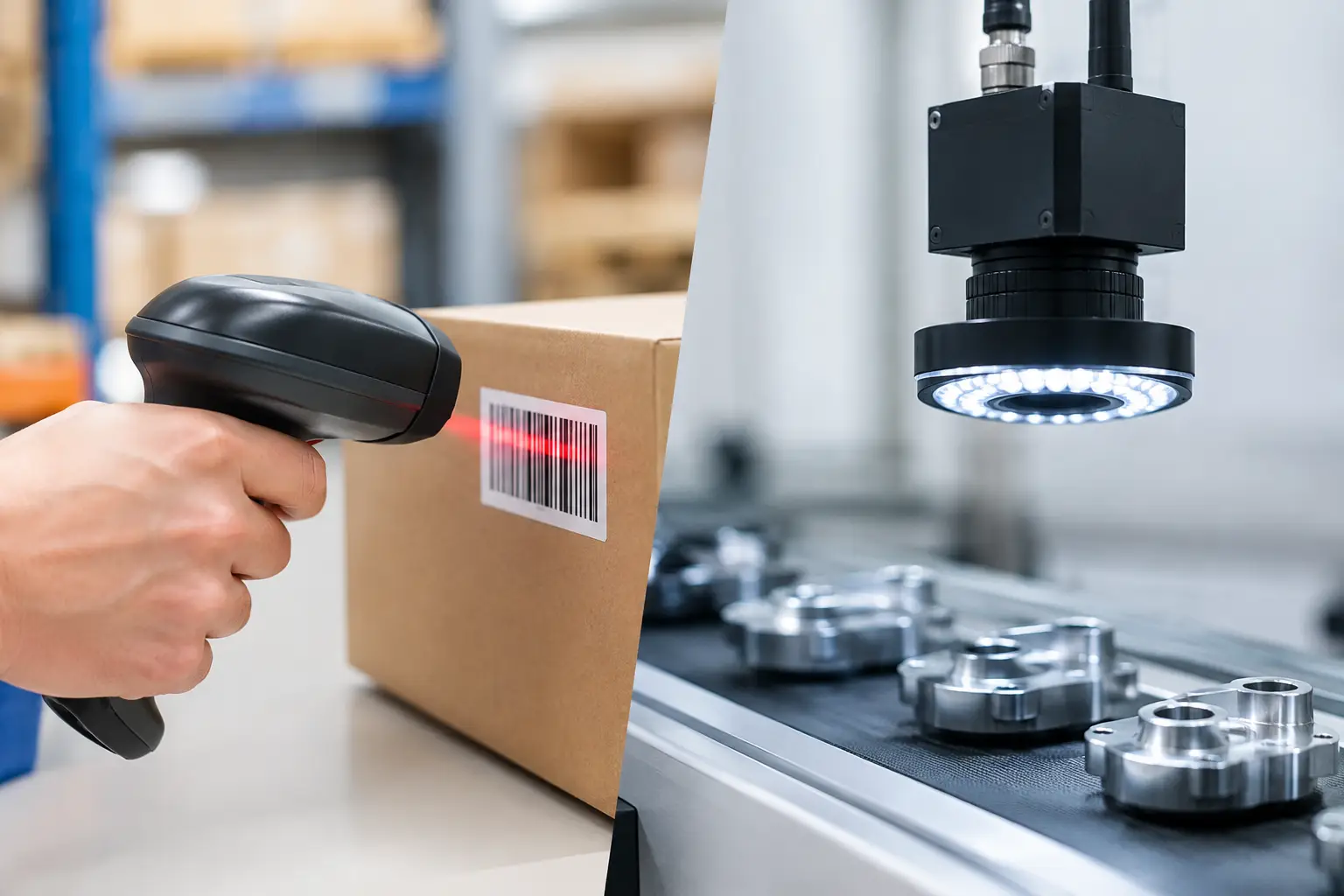
A barcode scanner reads a machine-readable code and sends the resulting ID to a warehouse management system, manufacturing execution system, ERP, or mobile application. The system then uses that ID to validate a task: receive a pallet, confirm a bin location, pick an order, consume a component, or dispatch a shipment.
A vision system uses one or more cameras and software to interpret images or video. Depending on the use case, it may read a barcode or QR code, recognize objects, count items, inspect labels, detect PPE, identify damage, monitor zone activity, or compare physical events against a defined operating rule.
The difference matters because a scanner typically requires a deliberate human action. Someone points a handheld device, pulls a trigger, and receives a pass or fail response. A vision system can observe continuously or automatically at a fixed process point. It can see events that staff do not scan, do not have time to inspect, or may not realize are exceptions.
Neither approach guarantees accuracy on its own. A scanner can validate the wrong barcode if the wrong label is applied. A camera can identify an anomaly but still need a workflow to assign, investigate, and close the exception. The operational result depends on the control design around the technology.
Where Barcode Scanners Remain the Best Tool
Barcode scanning is the right answer when the process needs a fast, explicit transaction tied to a known master record. This is why it remains central to receiving, putaway, replenishment, picking, cycle counting, batch traceability, and asset handover.
In a warehouse, scanning supports discipline at each movement point. A forklift operator scans the pallet license plate and destination bin before putaway. A picker scans the location, item, and tote to prevent a short pick or item substitution. At dispatch, the operation scans cartons or pallets against the shipment before loading. Each event creates a timestamped, user-linked audit trail.
The commercial case is also clear. Handheld scanners, mobile computers, printed labels, and standard integration patterns are well understood. Teams can learn the core workflow quickly, and supervisors can immediately see exceptions such as invalid location, expired lot, or incorrect serial number.
Barcode scanners are especially effective where work is variable and mobile. A field engineer scanning equipment at a customer site, a warehouse associate working across wide aisles, or a production operator issuing components at multiple lines all need a lightweight tool that travels with them.
Their limitation is that they only know what was scanned. If an associate scans a pallet correctly but leaves it in the wrong staging lane, the transaction may look complete while the physical process is not. If a carton has a readable barcode but crushed corners, a scanner will not flag the quality issue.
Where Vision Systems Create Operational Control
Vision systems are strongest at fixed, repetitive, high-volume, or high-risk process points. These are places where the operation benefits from continuous observation rather than another manual task.
Consider a loading bay. Cameras can verify whether the correct pallet configuration entered a staging zone, detect a vehicle arriving or departing, record loading activity, and flag dwell time beyond a defined threshold. At a packing station, vision can check label presence, label placement, item count, carton condition, or whether an operator followed the required packing sequence.
On a production line, vision can inspect cap placement, print quality, component presence, fill level, color variation, or assembly orientation. In cold-chain operations, cameras can support dock-door monitoring and physical event verification alongside temperature telemetry. The camera does not replace sensor data, but it can provide evidence of why a temperature excursion occurred, such as a door left open during a delayed transfer.
Vision is also useful when compliance depends on behavior. PPE detection, restricted-zone monitoring, queue management, and proof-of-service checks all require the system to observe people, objects, and context. These are difficult to enforce with scan transactions alone.
However, computer vision should not be treated as a general CCTV upgrade. Camera position, lighting, line speed, occlusion, product variability, retention requirements, and escalation rules determine whether a deployment produces usable intelligence or merely more footage. A proof of concept should test the actual environment, including night shifts, packaging changes, reflective surfaces, and peak operating volumes.
Accuracy Is Not the Same as Assurance
Operations teams often ask which technology is more accurate. The better question is: accurate about what?
Barcode scanning is highly accurate at identifying a label when the code is printed correctly, accessible, and scanned at the required point in the workflow. It is excellent for transactional assurance. The system can block an unauthorized movement before it happens.
Vision provides physical assurance. It can identify that a pallet is missing, a label is absent, a carton is damaged, or an activity occurred outside the expected sequence. But its confidence levels may vary with environmental conditions and model training. For a critical quality decision, the process may need a review queue, a second confirmation method, or defined tolerances rather than a fully automated rejection.
This distinction is important for auditors and operations directors. A scan record proves that a user completed a transaction. Video evidence and vision events can help prove that the real-world action matched the transaction. In regulated or dispute-prone workflows, both records can be valuable.
Cost Depends on the Process, Not the Device
A barcode deployment usually has a lower entry cost. The organization purchases devices, printers, labels, charging infrastructure, and software configuration. Ongoing costs include label consumables, device management, replacement hardware, Wi-Fi coverage, training, and support.
Vision has different cost drivers. Cameras, edge hardware or cloud processing, network design, storage, model configuration, integration, and ongoing monitoring all need to be considered. A single camera may be inexpensive, but a production-grade vision workflow is not simply a camera purchase. It is an operational system that must remain reliable after layout changes, new SKUs, or changing light conditions.
The return should be measured against the failure being controlled. If a scan prevents occasional pick errors, its value is tied to rework, returns, and inventory accuracy. If vision prevents recurring shipment disputes, production defects, safety incidents, or unverified service claims, the value may be substantially higher. The right investment is the one that removes a measurable operational loss or reduces a material control risk.
Choosing the Right Design for Your Operation
Start with the decision that must be made at the process point. If the system needs to know, “Which item, lot, serial number, or location is this?” scanning is usually the foundation. If it needs to know, “Was the right physical action performed, and was the condition acceptable?” vision may be required.
Then assess the work environment. Mobile, exception-heavy work favors handheld scanning. Fixed stations, conveyor lines, gates, docks, and controlled zones favor cameras. High-throughput operations may benefit from automated code reading, where industrial cameras read barcodes without requiring an operator to trigger a handheld device.
Integration should be designed early. A useful vision alert must create an accountable next step: hold the shipment, notify the supervisor, open a quality case, request a recount, or attach evidence to the transaction. Similarly, scan failures should not become informal workarounds. They need clear exception handling, role-based approvals, and audit trails.
For enterprise groups, standardization also matters. A site may begin with one loading bay or one critical production cell, but the data model, user roles, retention policies, and ERP interfaces should support expansion across facilities. This is where a unified workflow, vision, and integration layer becomes more valuable than isolated point tools. Snapdec applies this approach by connecting operational events to the workflows, dashboards, and audit records teams need to act on them.
The Hybrid Model Often Delivers the Best Result
In many industrial environments, the answer is not barcode scanners or vision systems. It is a controlled combination.
A picker scans each item and tote to validate the order. Vision at the packing bench confirms that the carton contains the expected item count, label, and packing condition. At dispatch, scanning confirms shipment association while cameras create evidence of loading activity. The result is stronger than either system operating alone: explicit transaction control plus physical verification.
This hybrid model also improves root-cause analysis. When inventory, quality, or customer-service issues arise, managers can compare the transaction history with observed process events. That shortens investigations and shifts improvement discussions away from assumptions.
Begin with the failure that costs your operation the most, then choose the smallest reliable control that can prevent it. When the process demands proof beyond a scan, vision becomes a practical operating tool rather than a technology experiment.
KEEP READING
Want the version that applies to your operation?
Articles only go so far. Book a no-obligation session and we'll walk your process end to end.
Book a demo →