

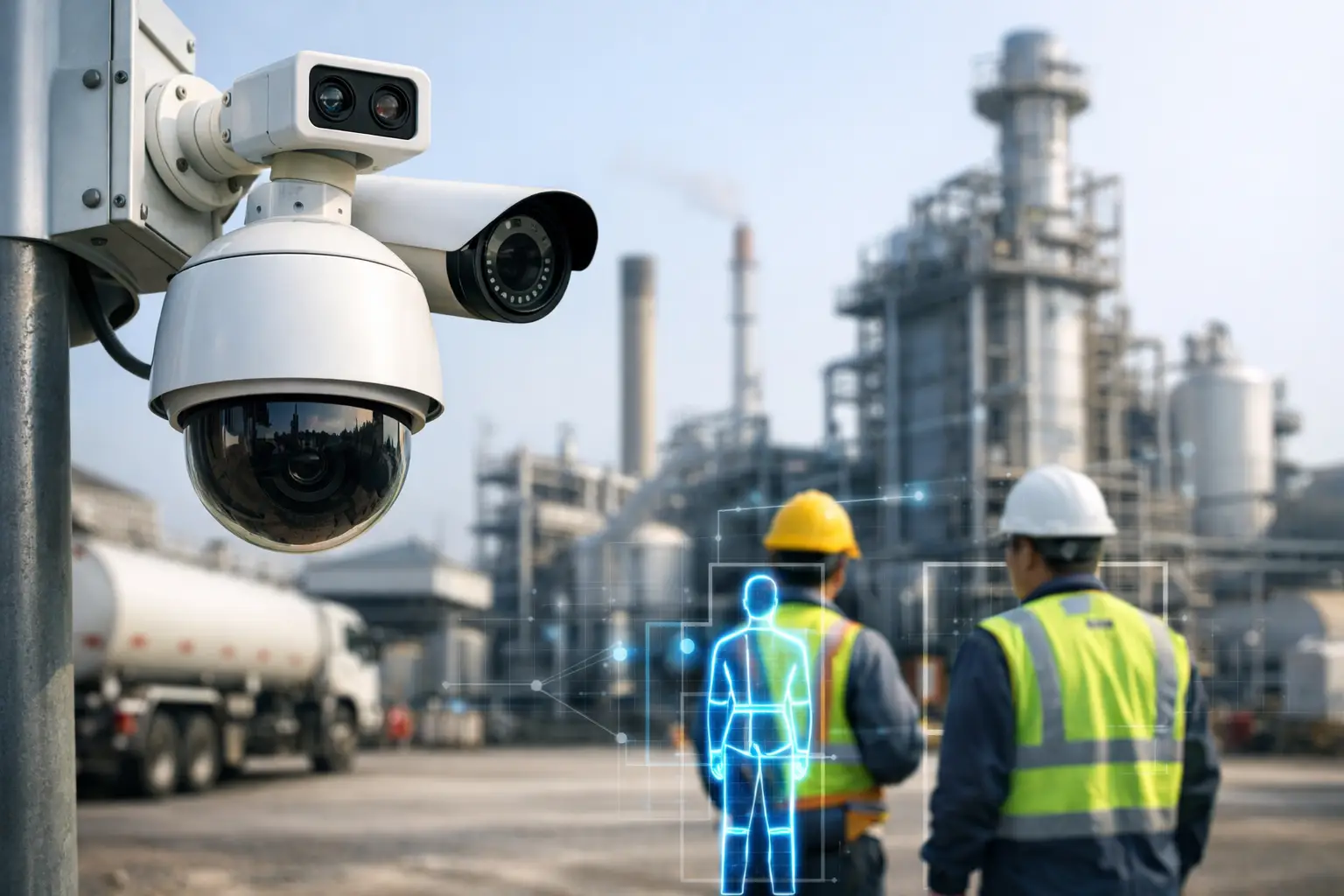
AI CCTV safety monitoring turns cameras into actionable controls for PPE, restricted zones, vehicle risk, and audit-ready incident response at work sites.
A near-miss at a loading bay rarely starts as a major event. It may be a pedestrian stepping into a forklift path, a pallet left in an emergency aisle, or a contractor entering a controlled area without required PPE. AI CCTV safety monitoring gives operations teams a way to identify these conditions while they are still correctable, rather than discovering them during an incident investigation.
For factories, warehouses, yards, and logistics networks, the value is not simply another camera feed. The value is a controlled operational signal: what happened, where it happened, when it happened, who needs to act, and whether the issue was resolved. That distinction matters when safety performance must stand up to management review, customer audits, and regulatory scrutiny.
What AI CCTV Safety Monitoring Actually Does
Traditional CCTV records video for later review. That is useful after theft, damage, or an accident, but it relies on someone knowing what to look for and spending hours searching footage. Computer vision adds real-time detection to the camera network. It analyzes defined visual conditions and raises an event when a rule is breached.
In an industrial setting, those rules can cover PPE compliance, people in vehicle exclusion zones, blocked fire exits, unsafe access to machinery areas, prolonged worker inactivity, crowding, intrusion, or missing safety barriers. The system does not replace safety officers or supervisors. It extends their coverage across locations and shifts where constant manual observation is not practical.
The strongest deployments are designed around specific risk controls. A camera at a warehouse dock may detect pedestrians crossing into a forklift lane. A camera near a chemical storage area may verify helmet, vest, and access compliance. A camera at a production line may identify unauthorized entry beyond a machine guard boundary. Each use case should map to an existing safety procedure and an accountable response owner.
Start With the Hazards That Create Operational Exposure
Many organizations begin with a broad request to "use AI on our cameras." That approach usually creates too many alerts and too little value. A better starting point is a short list of recurring exposures that are visible, measurable, and action-ready.
Look at incident records, near-miss logs, safety walk findings, insurer observations, and audit nonconformities. Where do unsafe acts occur repeatedly? Which locations are difficult for supervisors to monitor? Which controls depend on staff remembering a rule during a busy shift?
The right first use case is often not the most technically impressive. It is the one where detection can prevent a credible loss and trigger a clear response. Vehicle-pedestrian separation is a common example because the risk is high, the area is visible to cameras, and the corrective action is immediate. PPE checks can also work well at controlled entry points, provided the required equipment is consistent and camera angles are appropriate.
Some risks are less suitable for vision alone. A camera can identify a person in a restricted zone, but it cannot determine whether a machine has been electrically isolated. It can observe a door left open, but not confirm product temperature inside a cold room. These cases benefit from combining video events with IoT telemetry, access control, maintenance systems, or digital permit workflows.
From Alert Noise to a Managed Safety Workflow
An alert without ownership is only a notification. Industrial teams already receive emails, radio calls, WhatsApp messages, and system exceptions throughout the day. If AI CCTV events are added without a workflow, operators quickly learn to ignore them.
A usable safety monitoring design defines the full response path. When the system detects a person without a safety vest in a vehicle zone, it should record the camera, timestamp, event type, and confidence level. It should then route the event to the appropriate supervisor or control room, based on location and shift. The recipient needs a simple choice: verify, dismiss, escalate, or assign corrective action.
For repeated or high-severity events, the workflow should create an auditable case. That may include the event image or video clip, corrective action, responsible person, due date, verification evidence, and closure approval. The objective is not to create bureaucracy for every minor breach. It is to distinguish between a one-off false alert, a correctable behavior issue, and a recurring control failure that requires management attention.
This is where integration becomes commercially significant. Camera intelligence is more valuable when it connects to enterprise workflow, incident management, HR access records, contractor management, maintenance, or EHS reporting. A stand-alone dashboard may demonstrate the technology. An integrated process changes the operating model.
AI CCTV Safety Monitoring Needs Site-Specific Configuration
Computer vision performance depends heavily on the physical environment. A model trained to detect high-visibility vests may struggle if workers wear rain gear, if lighting changes dramatically between shifts, or if a camera is mounted too high to see torso-level PPE. Camera placement, field of view, occlusion, glare, dust, and network reliability all affect results.
This is why deployment should include a site survey and a defined calibration period. Teams need to test real scenarios: workers walking alone and in groups, forklifts reversing, pallets obstructing sight lines, contractors wearing different PPE, and activity under day and night lighting. Thresholds can then be adjusted to suit the operational risk.
False positives and missed detections are trade-offs, not signs that the concept has failed. A low alert threshold catches more potential events but may burden supervisors with noise. A high threshold produces fewer alerts but can miss behavior that should have been addressed. The correct balance depends on the consequence of the event, the volume of traffic, and the team's ability to respond.
A mature rollout also defines what the system is not intended to do. It should not be positioned as an automatic disciplinary tool or as a substitute for competent safety management. Video analytics can identify observable conditions. People must still investigate context, coach teams, improve layouts, and enforce procedures fairly.
Privacy, Governance, and Workforce Adoption
Safety surveillance requires governance from the beginning. Employees, contractors, and visitors should understand where monitoring applies, what types of safety events are detected, how footage is retained, and who can access it. Clear policy reduces uncertainty and supports adoption.
Role-based access is essential. A line supervisor may need to review an assigned event, while EHS leaders need trend reporting across sites and IT administrators manage platform configuration. Not every user should have unrestricted access to live footage or historical clips. Audit trails should show who reviewed, exported, changed, or closed an event.
The message to the workforce also matters. If the rollout is framed only as enforcement, teams may see the system as punitive and resist it. If it is framed as a practical tool for preventing avoidable injuries, improving traffic discipline, and correcting hazards before someone is harmed, adoption is more likely to be constructive. Management must support that message with consistent behavior: use the data to improve controls, not selectively target individuals.
For organizations operating across multiple sites, governance should be standardized while rules remain locally configurable. A group may require common reporting categories and retention policies, but a cold-chain facility, manufacturing plant, and distribution center will have different risk profiles and camera layouts.
Measuring Value Beyond the Number of Alerts
The number of alerts generated is not a success metric. In fact, a declining alert volume may be positive if it reflects safer behavior and better site controls. Leaders should measure whether the system is reducing exposure and improving response discipline.
Useful indicators include verified unsafe events by location, repeat events by shift or contractor, average time from detection to acknowledgment, overdue corrective actions, and recurring hazards by category. These measures can reveal issues that safety walks alone may not surface, such as a crossing point that becomes unsafe during peak dispatch windows or a particular zone where PPE compliance falls at shift handover.
Financial value comes from avoided incidents, less manual video review, fewer unplanned disruptions, stronger audit evidence, and better use of supervisory time. The return will vary by site. A high-traffic warehouse with mixed forklift and pedestrian movement may justify a broader deployment than a low-activity facility with stable access controls. The business case should reflect the actual risk profile, not a generic camera count.
Building a Deployment That Teams Use on Monday
A practical program begins with one or two high-priority zones, a defined event workflow, and measurable acceptance criteria. Prove the camera angles, detection rules, response ownership, and reporting process before scaling across the network. Then expand based on verified risk reduction and operational readiness.
SnapAI Vision can support this model by combining CCTV-based detection with configurable workflows, role-based access, dashboards, and audit trails through Snapdec's broader industrial platform. The aim is not to create another screen for control rooms. It is to turn visual safety signals into accountable work that can be tracked from detection through closure.
The most effective safety systems make good decisions easier during a busy shift. If a supervisor can see the event, assign action, confirm correction, and identify repeat exposure without searching through hours of footage, the camera network has become part of the safety operating system rather than a passive record of what went wrong.
KEEP READING
Want the version that applies to your operation?
Articles only go so far. Book a no-obligation session and we'll walk your process end to end.
Book a demo →