

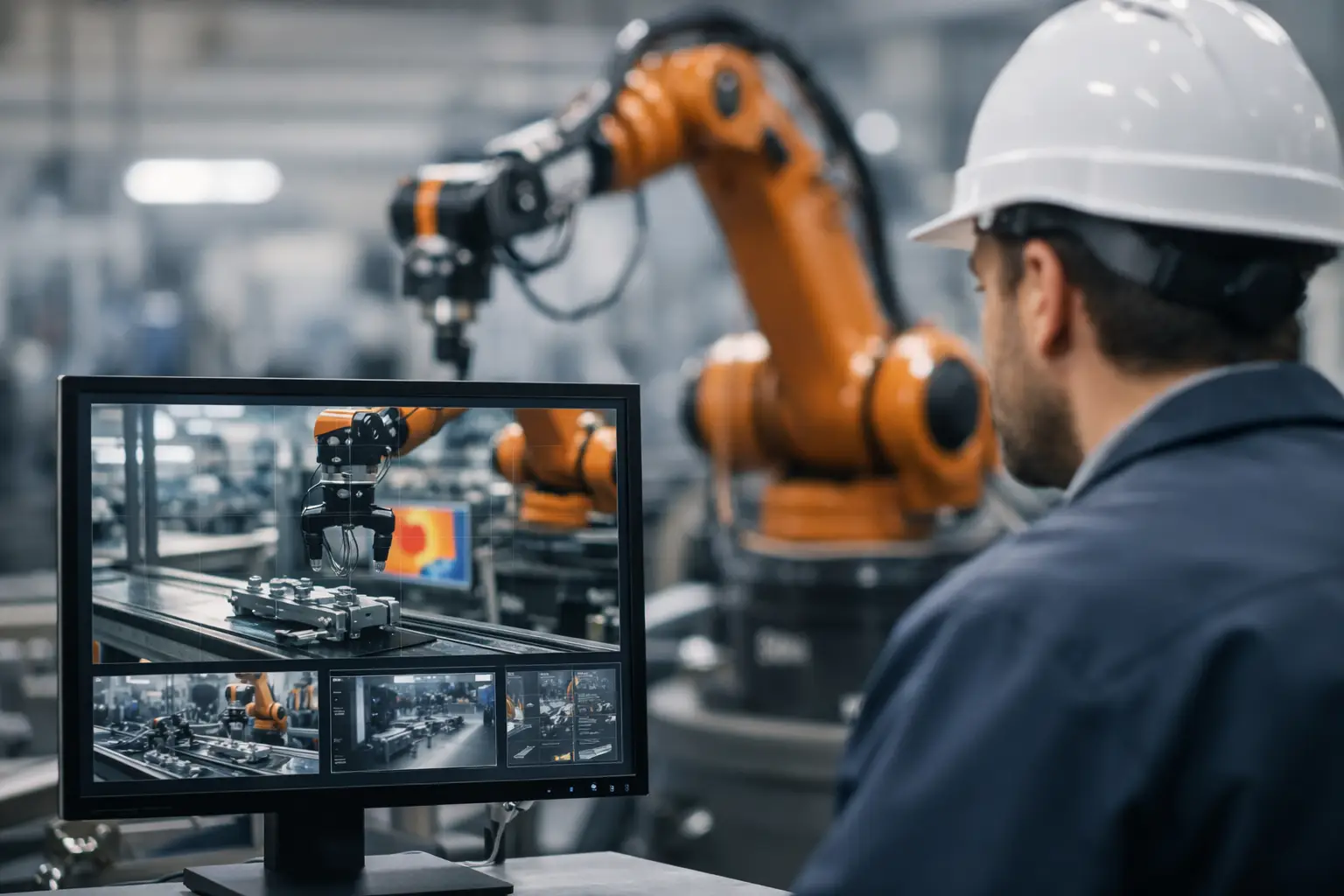
Computer vision turns existing cameras into audit-grade operational intelligence for safer, faster manufacturing, warehousing, and logistics execution.
A missed pallet scan, an open cold-room door, a worker entering a restricted zone, or a packing error can become expensive long before it reaches a report. Computer vision gives operations teams a way to see those events as they happen, using camera footage as structured operational data rather than passive security evidence.
For manufacturers, warehouse operators, and logistics leaders, the value is not a camera with an AI label. It is earlier intervention, defensible records, and better control of processes that are currently checked through walkarounds, paper forms, spreadsheets, or incident reviews after the damage is done. The right deployment turns visual evidence into a workflow trigger that the team can act on Monday morning.
What Computer Vision Means in Industrial Work
Computer vision is software that interprets images or video to recognize objects, movement, conditions, and events. In an industrial setting, it can analyze CCTV feeds or purpose-installed cameras to identify whether a person is wearing required PPE, whether a loading bay is occupied, whether cartons are damaged, or whether a vehicle has arrived at the correct gate.
This is materially different from conventional CCTV. Traditional camera systems record footage for security and retrospective investigation. A computer vision system is configured to detect operational conditions in real time, classify events against business rules, and route relevant alerts or evidence into the systems that manage work.
That distinction matters because industrial teams do not need more video to watch. They need answers: Was the dispatch lane clear? Did the forklift enter a pedestrian zone? Were the required labels present? How long did a truck wait at the dock? Did the production line stop, and what was happening when it did?
Where Computer Vision Produces Measurable Value
The strongest use cases begin with a repeated operational event that is visible, consequential, and difficult to control consistently through manual observation. Camera-based detection works particularly well when the organization already has CCTV coverage but lacks timely accountability from that footage.
Manufacturing and quality control
On the factory floor, vision can verify product presence, detect visible defects, count units, monitor line conditions, and identify deviations in defined work areas. A system may detect a missing component before packing, identify a blocked aisle near a production cell, or record machine-state signals that support OEE analysis.
The trade-off is that visual inspection has limits. Fine internal defects, chemical composition, and measurements beyond camera resolution may still require sensors, gauges, or laboratory checks. Computer vision is most effective when it strengthens existing quality controls instead of being expected to replace every inspection method.
Warehouse execution
Warehouses lose time and accuracy in small, repeated moments: pallets left in staging too long, stock placed in the wrong zone, loading activity that cannot be verified, or queues building at a dock without escalation. Vision can detect occupancy, count pallets or vehicles, validate movement through defined areas, and create evidence for loading and dispatch events.
For temperature-sensitive operations, cameras can also complement telemetry. A vision event may confirm a door was left open while SnapIOT records the temperature trend that followed. Together, these records give operations and compliance teams a clearer picture than either system can provide alone.
Logistics yards and transport operations
At yards, gates, and cross-docking facilities, the commercial case often centers on turnaround time and proof of execution. Computer vision can recognize vehicle arrivals, record entry and exit times, monitor queue length, detect bay occupancy, and identify unsafe activity around loading zones.
This supports better carrier management, more accurate billing disputes, and practical performance reporting. It also reduces dependence on handwritten logs that may be incomplete when the site is busy.
Safety, compliance, and audit readiness
PPE detection, restricted-area monitoring, spill or obstruction detection, and unsafe proximity alerts are common starting points. These applications should be handled carefully. The aim is not to create a surveillance culture or issue alerts without context. The aim is to prevent avoidable risk and provide evidence that supervisors can review fairly.
For audit-sensitive operations, event records should retain timestamps, camera location, rule context, acknowledgment status, and the action taken. An image alert without a workflow, owner, and audit trail is still just an alert.
Computer Vision Must Connect to the Workflow
The difference between a pilot that impresses visitors and a system that improves operations is what happens after detection. If a camera identifies an unsealed carton or a person without a safety helmet, the organization needs a defined response: who receives the notification, how they verify it, when they escalate it, and where the closure is recorded.
This is why computer vision should sit within a broader operational architecture. The event may create a task for a shift supervisor, trigger a maintenance request, hold a shipment for inspection, update a dashboard, or attach evidence to an audit case. Integration with warehouse management, ERP, manufacturing, IoT, and workflow systems prevents teams from rekeying information or chasing screenshots through email.
Snapdec approaches this through an AI-native operating model where vision events can feed workflow orchestration, dashboards, role-based approvals, and enterprise integrations. The objective is practical: detection must produce accountable work, not another disconnected screen for the control room.
What Determines Whether a Deployment Works
Model accuracy matters, but it is only one part of the delivery. Industrial environments introduce changing light, reflective packaging, high-visibility vests, dust, occlusion, camera vibration, and people or assets that look similar from a distance. A model that performs well in a controlled demonstration may fail at a live loading bay at 6:00 a.m. or during peak shift activity.
A deployable program starts with four decisions:
- Define one measurable operating problem, such as reducing unverified loading events or shortening dock dwell time.
- Confirm camera position, field of view, lighting, network capacity, and retention requirements before selecting the model.
- Set a human review path for exceptions, especially where safety, disciplinary action, quality release, or customer billing is involved.
- Establish the system of record for every event, including ownership, escalation rules, evidence retention, and closure status.
False positives and false negatives must be managed openly. A highly sensitive model may catch more potential incidents but generate alert fatigue. A stricter threshold can reduce noise but miss edge cases. The correct balance depends on the cost of a missed event, the volume of activity, and the availability of people to review alerts.
Edge Processing, Cloud Processing, and Data Governance
Architecture should follow operational and governance requirements. Edge processing analyzes video near the camera or on-site, which can reduce latency and avoid transmitting continuous footage. It is often appropriate for safety alerts, remote facilities with unstable connectivity, or sites with tight data-handling requirements.
Cloud processing can be useful when central teams need multi-site reporting, model management, and scalable compute resources. Many enterprises use a hybrid approach: detect time-critical events locally, then send event metadata and approved clips to centralized systems for reporting, investigation, and continual improvement.
Data governance should be designed before rollout, not after a complaint. Teams need clear policies for retention periods, access rights, location of stored footage, use of personal data, and vendor responsibilities. In unionized, regulated, or high-security environments, legal, HR, security, and operations stakeholders should agree on the purpose and boundaries of the deployment early.
Start With an Operating Decision, Not a Camera Count
A productive first project is narrow enough to measure and important enough to matter. For example, a warehouse may focus on dock occupancy and truck turnaround, while a factory may target PPE compliance in a defined high-risk area. Baseline current performance before activation, then track the change in incident rate, response time, labor hours, dwell time, rework, or audit exceptions.
Avoid buying vision technology simply because cameras are available. Some processes are better solved with barcode discipline, a warehouse rule, a physical sensor, or clearer supervisory ownership. Computer vision earns its place when visual detection closes a real information gap faster or more reliably than those alternatives.
The most valuable camera is not the one that identifies the most objects. It is the one that helps a supervisor make a better operating decision before a small exception becomes lost inventory, delayed dispatch, noncompliance, or an avoidable safety event.
KEEP READING
Want the version that applies to your operation?
Articles only go so far. Book a no-obligation session and we'll walk your process end to end.
Book a demo →