

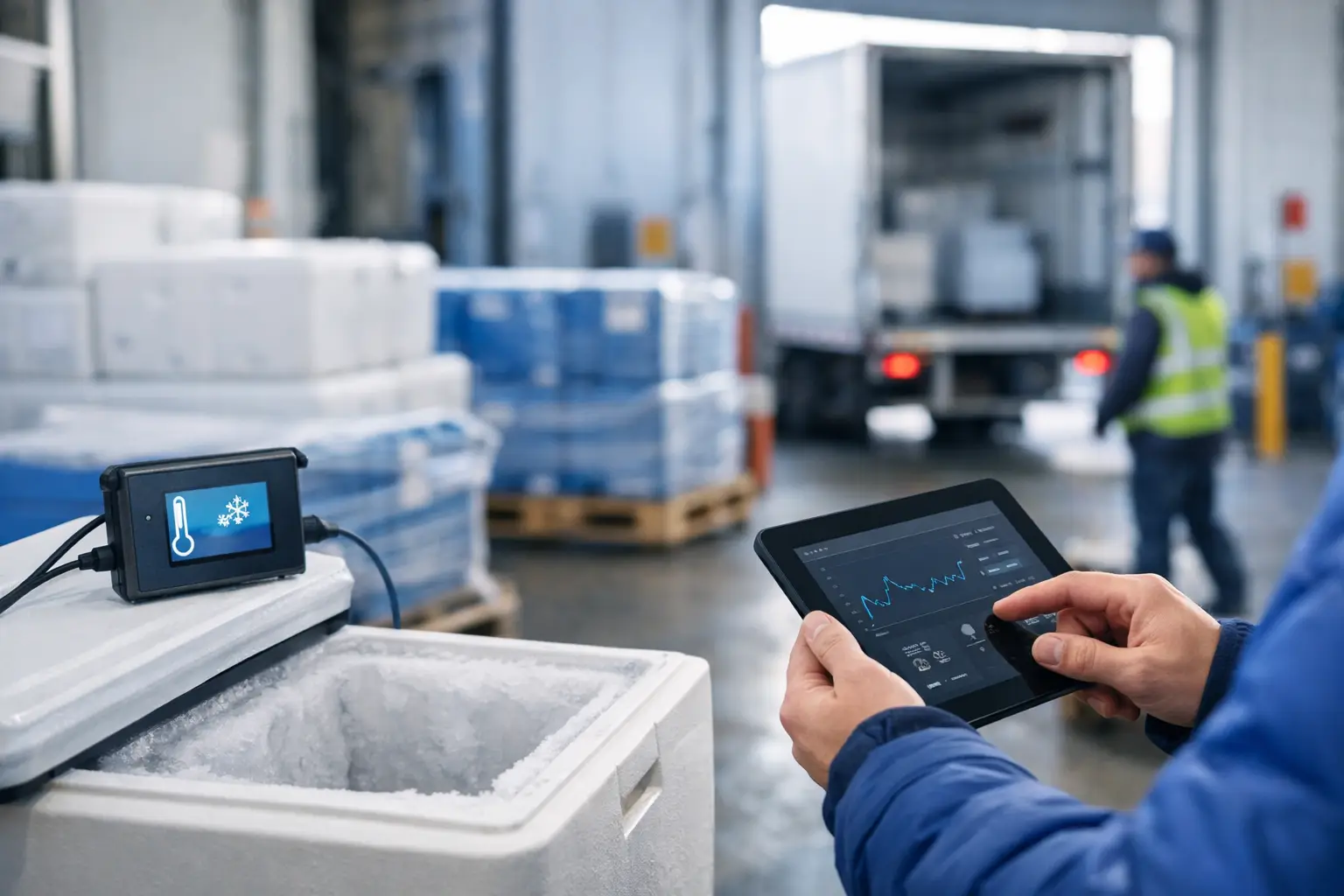
Cold chain temperature monitoring gives operators real-time alerts, audit-grade records, and faster action across storage, transport, and handoffs daily.
A freezer door left ajar for 18 minutes can create a much larger problem than a high-temperature reading. If nobody sees the event, verifies the affected stock, records the decision, and fixes the cause, a minor excursion becomes an inventory, customer, and audit exposure. Cold chain temperature monitoring is therefore not just about collecting sensor data. It is about controlling the response to temperature risk across storage, transport, and handoffs.
For food, pharmaceuticals, laboratory materials, and temperature-sensitive industrial goods, product quality depends on conditions that must be proven after the fact. Operations leaders need more than a chart on a screen. They need a system that identifies exceptions early, assigns accountability, preserves evidence, and connects temperature events to the inventory and workflows affected.
What cold chain temperature monitoring must deliver
A working cold-chain program starts with continuous, reliable measurement at the points where product is stored or moved. That includes cold rooms, freezers, blast chillers, refrigerated trucks, staging areas, and containers. But temperature readings alone do not explain whether an event was operationally significant.
A useful platform records the location, timestamp, sensor identity, temperature range, duration of the deviation, and the people who acknowledged and resolved it. It should also retain calibration records, configuration history, and a clear audit trail of changes. This is what turns environmental telemetry into audit-grade operational evidence.
The business case is direct. Real-time monitoring reduces product loss by allowing teams to intervene before a deviation becomes prolonged. It reduces labor spent compiling spreadsheets and chasing paper records. It also protects customer confidence when a consignee, quality manager, or auditor asks whether the required storage conditions were maintained.
The right level of control depends on the product and risk profile. A warehouse holding frozen ingredients may focus on freezer alarms and door discipline. A life sciences distributor may require tighter thresholds, validated equipment, formal incident reviews, and longer record retention. The operating model should match the consequence of failure, not simply deploy the most sensors possible.
Where temperature control usually breaks down
Most cold-chain failures occur at transitions, not in the center of a well-managed cold room. Receiving docks, temporary staging, vehicle loading, route delays, power interruptions, and manual defrost activity are common pressure points. A temperature system that only monitors fixed storage locations leaves critical gaps in the chain of custody.
Fragmented operations make the issue worse. One site may use standalone data loggers, another may rely on handwritten checks, and a transport partner may provide reports only after delivery. By the time quality teams receive the information, the product has already moved, and determining which pallet, batch, or customer order was exposed becomes a manual investigation.
Alert fatigue is another frequent problem. If every brief door opening creates a notification, teams eventually stop treating alerts as urgent. Thresholds need operational context. A short spike during planned loading may warrant observation, while a gradual rise in an unattended freezer overnight requires immediate escalation.
This is why temperature monitoring needs configurable rules rather than a single generic alarm setting. Different zones, products, and operating hours may need different acceptable ranges, delay periods, escalation paths, and corrective-action requirements.
Build the monitoring design around real workflows
Before installing devices, map how product actually moves. Trace receiving through putaway, storage, replenishment, picking, staging, loading, delivery, returns, and disposal. Identify every point where a product can wait outside its intended range, lose its location identity, or pass to a different party.
Temperature mapping should establish where sensors belong within each controlled environment. Cold air does not behave uniformly. Doors, evaporators, loading bays, racking height, airflow, sunlight exposure, and equipment layout can create warmer or colder zones. A single sensor placed in the most convenient location may give a false sense of control.
Once the physical design is clear, define the operating response. Every alarm should answer four practical questions: who is notified, how quickly must they act, what evidence must they capture, and who decides the disposition of affected inventory? Without these answers, alerts create activity but not control.
For a multi-site operator, standardization matters. Site managers may need local flexibility, but corporate quality and supply-chain leaders need common reporting, threshold governance, and escalation logic. A central view should make it easy to compare performance across warehouses, vehicles, and business units without forcing every facility into an unrealistic identical layout.
From alert to controlled corrective action
The value of real-time telemetry appears in the minutes after an exception begins. A practical workflow can follow four connected actions:
- Detect the deviation and confirm that it is not a sensor, connectivity, or maintenance issue.
- Notify the responsible role through the channels the team actually uses, with escalation if no acknowledgment is received.
- Link the event to the relevant location, equipment, inventory, batch, or shipment so the exposure can be assessed.
- Record the corrective action, verification result, and final product disposition in a time-stamped audit trail.
This workflow should not live in email alone. Email is useful for notification, but it is weak as a system of record. Decisions get buried in threads, attachments are difficult to retrieve, and managers cannot easily prove whether response targets were met.
A workflow-enabled platform creates a controlled sequence. A warehouse supervisor can acknowledge an alert, assign an engineering check, quarantine affected stock, attach photos or maintenance notes, and route the disposition decision to quality. Management can then see not only that temperatures were outside range, but how long resolution took and whether the same issue is recurring.
That distinction matters during audits and customer investigations. A temperature excursion does not automatically mean the product is unusable. However, the organization must be able to show a disciplined, evidence-based process for evaluating the event.
Integrate telemetry with warehouse and transport operations
Temperature data becomes substantially more useful when it is connected to operational systems. A warehouse management system can identify the stock stored in a compromised zone. A transport system can associate a vehicle event with a route, shipment, driver, and delivery window. ERP integration can support inventory status changes, holds, write-offs, and customer communication without duplicate entry.
This is particularly valuable for FEFO-managed inventory. When temperature-sensitive stock is placed on hold, the warehouse must prevent it from being picked or shipped while quality reviews the event. A disconnected monitoring dashboard may tell someone that a freezer was warm, but it cannot stop an operator from fulfilling an order with affected inventory.
Snapdec approaches this as an operational control problem, combining SnapIOT telemetry with workflow orchestration, role-based actions, dashboards, and integration to established enterprise systems. The goal is not another isolated sensor portal. It is a process that warehouse, quality, maintenance, and logistics teams use on Monday.
Connectivity also requires realistic planning. Some facilities have weak coverage in freezer rooms, concrete structures, or remote yards. Battery life can decline in low temperatures. Sensor selection, gateway placement, offline buffering, and maintenance access should be evaluated during deployment, not after alarms begin disappearing from the dashboard.
Measure performance beyond temperature compliance
A mature program tracks trends that point to operational improvement. Repeated high-temperature events at a loading dock may indicate poor staging discipline. Frequent compressor alarms may signal preventive maintenance gaps. Long acknowledgment times on weekends may reveal an escalation design that does not match actual staffing.
Useful management measures include excursion count by location, total duration outside threshold, average acknowledgment time, time to closure, recurring root causes, stock placed on hold, and product loss avoided or incurred. These indicators connect technical monitoring to cost control and accountability.
Do not judge the program only by the number of alarms. An increase in early alerts may be positive if it reflects better detection and quicker intervention. The more meaningful question is whether the organization is reducing prolonged excursions, preventable losses, and unresolved corrective actions over time.
A practical deployment path
Start with the highest-risk zones and flows rather than attempting a full network rollout on day one. Establish sensor placement, accepted ranges, escalation rules, and ownership for those areas. Test alarm delivery under real conditions, including overnight shifts, power interruption, and connectivity loss.
Then connect the monitoring process to inventory and quality workflows. This is the point at which teams move from seeing exceptions to managing their consequences. Train users by role, document standard actions, and review the first months of event data to tune thresholds and remove nuisance alerts.
Cold-chain control earns trust when it works quietly every day and speaks clearly when something goes wrong. Build for the operator facing a midnight alarm, the quality manager reviewing a batch hold, and the auditor asking for evidence six months later. Those are the moments when temperature data becomes operational control.
KEEP READING
Want the version that applies to your operation?
Articles only go so far. Book a no-obligation session and we'll walk your process end to end.
Book a demo →