
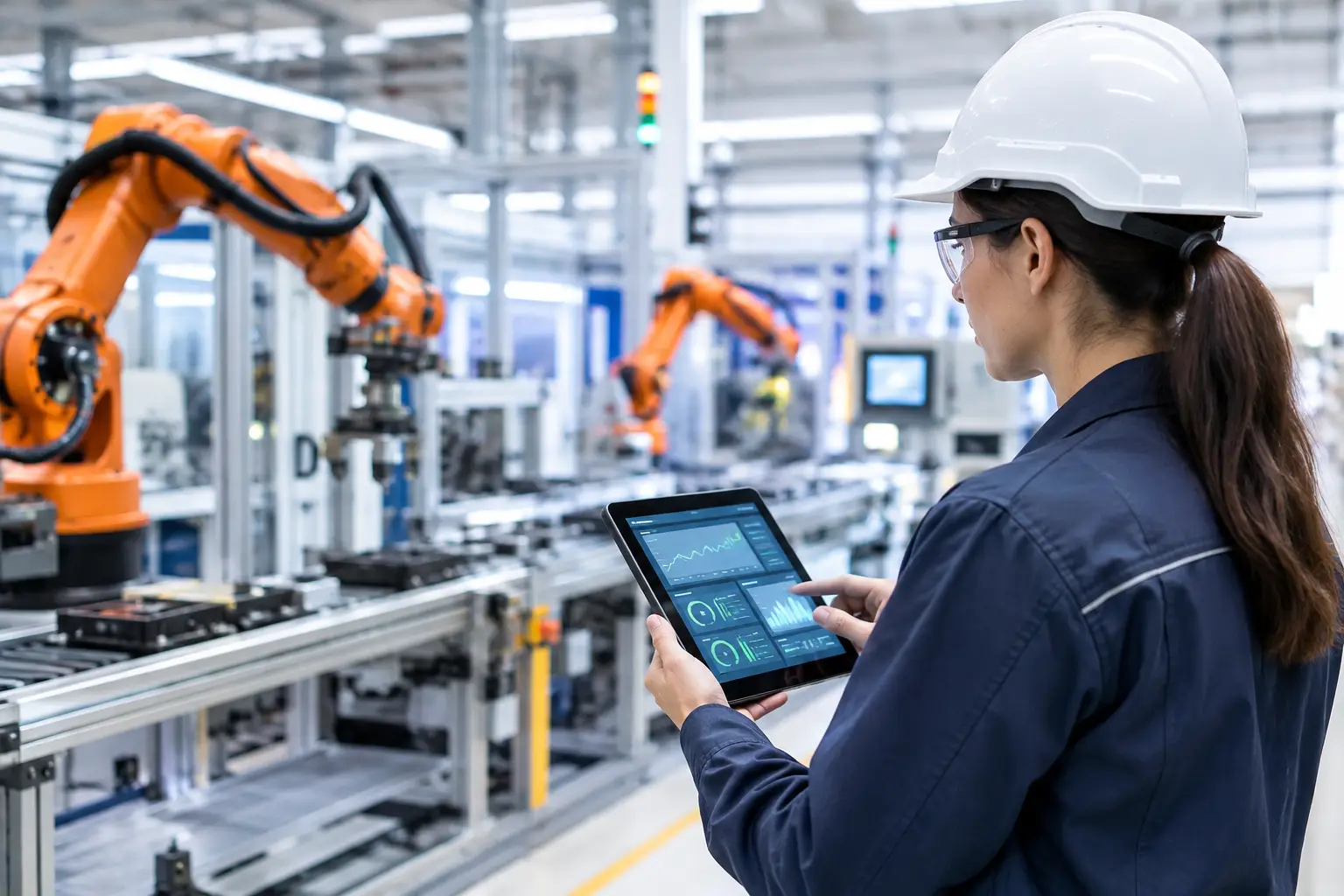
Smart factories turn shop-floor signals into controlled action, connecting production, quality, maintenance, and ERP data for clear, audit-ready results.
A missed production target rarely begins with one major failure. More often, it starts with a machine running below its expected cycle time, an operator using an outdated work instruction, a quality hold communicated over chat, or material that cannot be found when the line needs it. Smart factories address this operational drift by connecting what happens on the floor to the people and systems responsible for acting on it.
For manufacturers, the point is not to add more screens, sensors, or AI labels. It is to run production with greater control: accurate work orders, live machine and material status, repeatable quality checks, traceable approvals, and faster response when conditions change. The result should be something your team uses on Monday, not a dashboard that looks impressive during a pilot.
What smart factories actually mean in operations
A smart factory is a connected production environment where operational data is captured, interpreted, and routed into defined actions. It brings together production execution, machine telemetry, quality records, inventory movements, maintenance events, workforce tasks, and enterprise data such as orders, bills of materials, and accounting references.
That definition matters because many factories already have partial digital tools. They may have an ERP, PLCs on critical equipment, spreadsheets for output reporting, paper inspection forms, CCTV cameras, and WhatsApp groups for escalation. These tools can coexist for years without creating a controlled operating model. The information is present, but it is fragmented, delayed, or difficult to verify.
A smart factory closes that gap. A production supervisor should be able to see whether an order is progressing to plan. A quality manager should know which lot, operator, line setting, and inspection result apply to a nonconformance. A maintenance team should receive a service task based on an actual alarm pattern rather than a verbal report after downtime has already accumulated.
The technology stack varies by plant. Discrete manufacturing, process production, food operations, and cold-chain environments have different data requirements. The operating principle remains consistent: capture events at the point of work, apply business rules, retain an audit trail, and trigger the next responsible action.
The operational problems worth solving first
Factories do not need to digitize every process at once. The strongest business case normally starts with a workflow that has a clear cost, frequent exceptions, and a measurable baseline. For many plants, this means production reporting, material traceability, quality release, maintenance response, or finished-goods handoff to the warehouse.
Production status that can be trusted
Manual shift reports often arrive after the opportunity to correct a problem has passed. Even when operators report output accurately, the report may not explain why actual output differs from the plan. Was the loss caused by setup time, material shortage, micro-stoppages, defects, absenteeism, or a changeover that took longer than expected?
A connected execution workflow records production quantity, scrap, downtime reason, operator activity, and job progress as events occur. When paired with machine data, it can calculate actual cycle time, line availability, throughput, and OEE without relying entirely on end-of-shift estimation. This does not remove the need for supervisor judgment. It gives supervisors evidence before the shift is over.
Quality control with evidence, not recollection
Quality issues become expensive when the factory cannot identify affected material quickly. Paper forms, disconnected spreadsheets, and handwritten lot numbers make it difficult to demonstrate which inputs were used, who approved a release, or whether a required check was completed.
Digital quality workflows can enforce inspection steps based on product, process stage, customer requirement, or risk level. They can require photo evidence, measurement values, digital sign-off, corrective action ownership, and escalation when results fall outside tolerance. For regulated or customer-audited operations, the value is not simply faster reporting. It is audit-grade traceability that can be retrieved without assembling evidence from multiple folders.
Material flow that supports the schedule
A production plan is only as reliable as material availability. Inventory may look correct in the ERP while stock is misplaced, unlabelled, quarantined, allocated elsewhere, or held in a staging area that no one updated. This is particularly damaging where FEFO, FIFO, batch control, expiry dates, or customer-specific labeling rules apply.
Smart factory workflows should connect production consumption and output to warehouse execution. Barcode scans, mobile confirmations, weigh-scale data, and location rules can confirm that the right material was issued to the right order. Finished goods can move directly into defined quality, staging, or storage statuses. The objective is to reduce both line-side waiting and inventory uncertainty.
Maintenance triggered by operational reality
Preventive maintenance calendars remain useful, but calendar-only programs can miss the early signs of asset deterioration. Temperature variance, vibration changes, power anomalies, repeated short stops, and longer cycle times may all signal a problem before a full breakdown occurs.
IoT telemetry and machine connectivity allow maintenance teams to monitor those conditions against thresholds and patterns. The practical value comes when an alert creates a controlled workflow: notify the correct technician, assign a response deadline, capture diagnosis and repair details, record spare-part usage, and close the event against the asset history. Otherwise, a stream of alarms simply creates another unattended screen.
AI should improve decisions, not obscure accountability
AI has a real role in smart factories, especially where operations generate more signals than supervisors can review manually. Computer vision can identify PPE noncompliance, detect occupancy or queue conditions, verify process presence, and support visual inspection. AI models can flag unusual machine behavior, predict likely delays, extract data from documents, or help users retrieve the correct SOP from a controlled knowledge base.
But AI should not become an ungoverned decision-maker on the factory floor. A model may detect an anomaly, but the business must define who evaluates it, what action is permitted, when escalation is required, and how the outcome is recorded. In high-risk quality, safety, and compliance processes, human authorization remains essential.
The same caution applies to predictive analytics. A prediction is valuable only when the underlying data is reliable and the response process is clear. If downtime codes are inconsistent or machine states are poorly mapped, a sophisticated model can create false confidence. Start with clean event definitions, role-based workflows, and accountable exception handling. Add advanced AI where it improves speed, accuracy, or capacity.
Integration determines whether adoption lasts
Factories rarely replace every core system to become smarter. Most operate with established ERP, accounting, maintenance, warehouse, or production systems that contain critical master data and financial controls. A factory platform must work with that environment rather than create another isolated database.
This means integration is not a technical afterthought. Work orders, bills of materials, item masters, customer orders, inventory transactions, employee identities, and approval rules must have clear ownership. Teams need to know which system is the source of truth and which system executes each activity.
For example, an ERP may remain the financial and planning system of record, while a factory execution layer captures live shop-floor events and returns confirmed consumption, output, scrap, and status updates. A warehouse system may control locations and picking, while production requests material through governed replenishment workflows. This division of responsibility reduces duplicate entry without forcing every user to work inside a system designed primarily for back-office transactions.
Snapdec approaches this through connected workflow, vision, IoT, warehouse, and manufacturing capabilities built around shared access controls, dashboards, APIs, and audit trails. The purpose is not a one-size-fits-all factory template. It is a practical operating layer configured around the process discipline each site needs.
A deployment path that protects production
The most effective smart factory programs are phased. Start by mapping the current process as it is actually performed, including workarounds, handoffs, exception paths, and approval delays. Then choose one high-value workflow with defined owners and measurable outcomes.
A first deployment might focus on digitizing production reporting and downtime capture for one line, or on batch traceability from receiving through finished-goods release. The team should establish baseline measures before go-live: reporting timeliness, schedule adherence, unplanned downtime, scrap rate, inventory variance, release time, or audit preparation effort.
Pilot scope should be controlled, but it cannot be detached from real operations. Use live master data, actual shift teams, real devices, and real exception scenarios. Train operators in the context of their tasks, not in abstract software features. Supervisors and managers need their own operating routines as well, because a digital workflow fails when exceptions are visible but nobody acts on them.
After adoption is stable, extend the model to adjacent processes. A production event can drive quality sampling. A quality hold can block warehouse movement. A machine alarm can create a maintenance task. A completed work order can update inventory and trigger replenishment. This is where the compounding value of connected operations begins.
What to measure beyond the technology
A smart factory investment should be judged by operating results, not by the number of connected devices. Common measures include reduced unplanned downtime, lower scrap and rework, improved schedule attainment, faster lot traceability, fewer inventory discrepancies, shorter quality-release cycles, and less administrative time spent reconciling records.
The right metrics depend on the constraint in the business. A high-volume packaging line may prioritize OEE and changeover loss. A food producer may focus on batch genealogy, temperature compliance, and expiry management. A contract manufacturer may need stronger customer reporting, routing discipline, and accurate job costing.
The useful question is not, “How digital is the plant?” It is, “Which operational decision can we make earlier, more accurately, and with evidence?” Build around that answer. Smart factories earn their value when each connected signal leads to a clearer action, a named owner, and a result the business can measure.
KEEP READING
Want the version that applies to your operation?
Articles only go so far. Book a no-obligation session and we'll walk your process end to end.
Book a demo →