

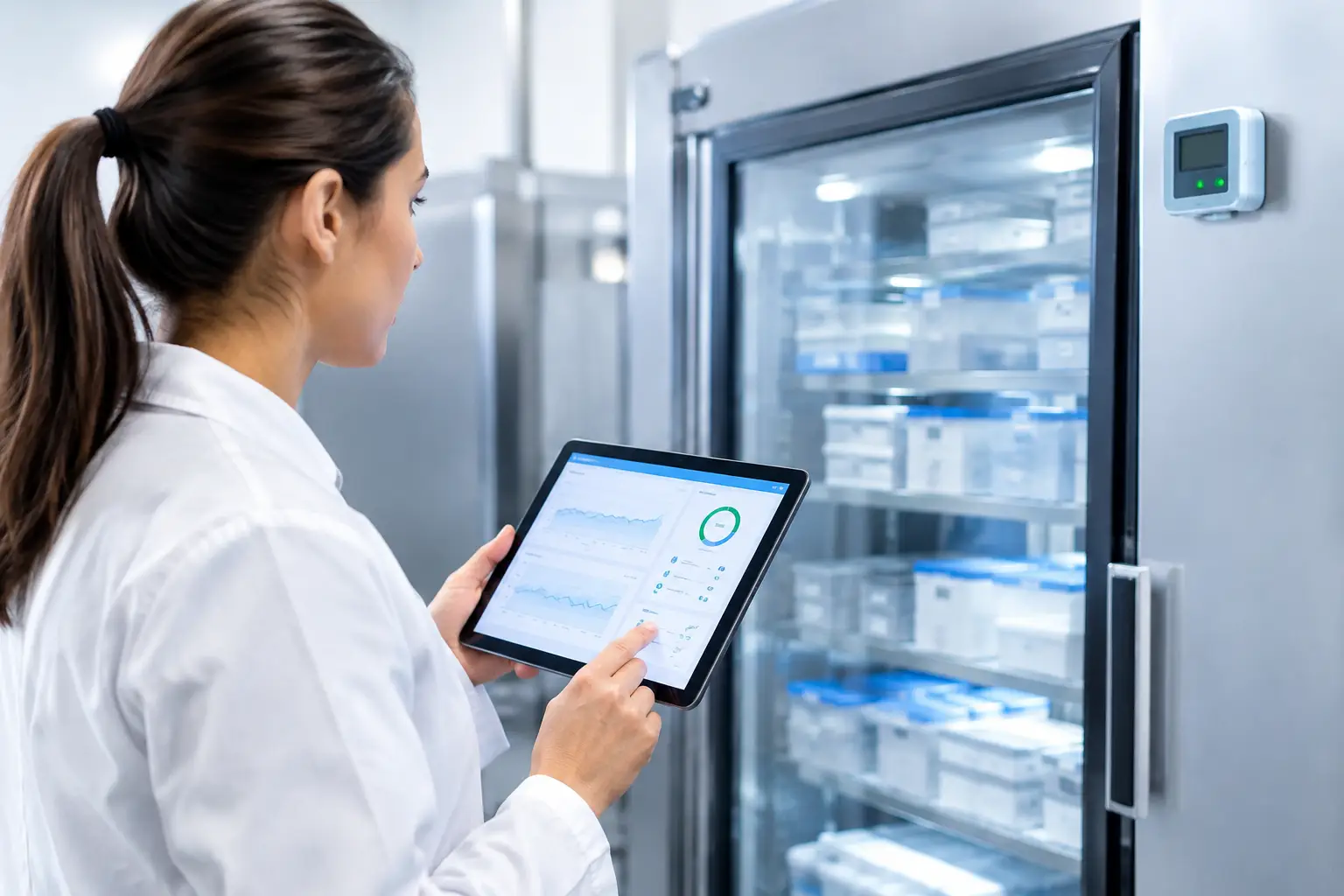
Learn how to track refrigerated chambers with continuous sensors, alerts, audit trails, and operational workflows that protect product and compliance.
A refrigerated chamber can appear stable during a walk-through and still have experienced a damaging temperature excursion overnight. That is why knowing how to track refrigerated chambers is not simply a facilities task. It is an operational control for product quality, inventory value, customer commitments, and compliance.
For warehouses, food processors, pharmaceutical distributors, laboratories, and cold-chain operators, the objective is not just to display a temperature on a screen. The objective is to create trustworthy evidence that every chamber stayed within its required range, identify exceptions early enough to act, and document what happened when conditions changed.
How to Track Refrigerated Chambers With Control
Effective chamber tracking combines calibrated sensing, reliable connectivity, defined alert rules, and accountable response workflows. Missing any one of these elements creates a gap. A sensor without escalation may record a failure nobody sees. An alert without a response procedure may generate noise but not protect stock. A corrective action without an audit trail is difficult to defend during an inspection or customer dispute.
Start by defining what each chamber is required to protect. The acceptable range for chilled produce, dairy, vaccines, seafood, frozen products, and temperature-sensitive industrial materials is not the same. Some goods tolerate short fluctuations; others require tight control with defined maximum excursion periods. Your system should reflect the actual product specification, not a generic temperature threshold applied across every site.
This definition should include the normal operating range, warning threshold, critical threshold, maximum permitted time out of range, who owns the response, and what happens to affected inventory. These rules turn telemetry into a working control system.
Place Sensors Where the Product Is at Risk
A single probe near a refrigeration unit rarely represents the real condition of a chamber. Air temperature can vary by height, proximity to doors, rack density, airflow patterns, evaporator cycles, and loading activity. The coldest point in a room may not be where your most sensitive product sits.
A practical installation begins with a temperature mapping exercise. Measure conditions across the chamber under normal operating conditions and, where relevant, during door openings, peak loading periods, and defrost cycles. This establishes hot and cold spots and shows where fixed sensors should be positioned.
Place sensors at product level, including likely warm zones near doors or upper racks, rather than only near cooling equipment. Larger chambers may need multiple sensors by zone. A freezer with high-value stock may also justify independent probes for air temperature and product-simulated temperature, because air can recover faster than the product itself.
Door-state monitoring adds valuable context. If a temperature rise occurs immediately after a door is held open, the corrective response differs from a rise caused by compressor failure. Monitoring compressor status, power supply, humidity, and defrost cycles can further improve diagnosis. The right mix depends on chamber size, product risk, and the cost of downtime.
Capture Continuous, Time-Stamped Data
Manual readings on paper forms create blind spots between inspections and leave room for missed entries, incorrect transcription, or backfilled records. Continuous monitoring is the baseline for chambers carrying regulated, perishable, or high-value goods.
Use industrial IoT sensors or data loggers that capture readings at an interval appropriate to the risk. A five-minute interval may be sufficient for a stable chiller holding low-risk goods. Higher-risk storage, frequent door activity, or strict contractual requirements may justify one-minute readings. More frequent data has a cost in connectivity, storage, and signal volume, but it can make the difference between identifying a brief excursion and discovering it too late.
Each reading should include the chamber ID, sensor ID, timestamp, measurement, unit, communication status, and calibration status. This matters when operations need to prove not only that a temperature was recorded, but which instrument recorded it and whether it was fit for use.
Connectivity must be designed for the building, not assumed. Refrigerated spaces, insulated panels, metal racking, and remote yards can weaken wireless signals. A site survey should validate coverage before deployment. Where connectivity is intermittent, use edge devices that store readings locally and synchronize once the connection returns. Data loss during an outage defeats the purpose of continuous monitoring.
Build Alerts That Drive the Right Response
An alert strategy should distinguish between a warning and an incident. If every minor fluctuation triggers a critical notification, teams become conditioned to ignore alarms. If thresholds are too relaxed, affected stock may remain undiscovered for hours.
A useful alert design accounts for temperature, duration, rate of change, and operating context. For example, a brief rise during a scheduled receiving window may trigger a warning to the floor supervisor. A sustained rise beyond the critical limit, especially outside operating hours, should escalate to the on-call engineer, warehouse manager, and quality owner.
Escalation should not stop at email. Operational teams need notifications through the channels they actively use, with acknowledgment requirements and time-based escalation if no one responds. The alert should state the chamber, latest temperature, duration of the breach, threshold exceeded, and the first action expected.
That first action must be practical: verify the door is closed, inspect the unit, move stock where necessary, contact maintenance, or place inventory on quality hold. The system should then capture the acknowledgment, actions taken, photographs or service notes where needed, and the time normal conditions were restored.
Connect Temperature Events to Inventory and Workflow
A temperature dashboard is useful. A temperature event connected to the affected pallet, batch, lot, and customer order is materially more valuable.
When a chamber exceeds its approved range, warehouse and quality teams should be able to identify the inventory stored in that zone during the exposure window. This is where chamber monitoring should connect with warehouse management, batch traceability, FEFO rules, quality holds, and ERP records. Instead of manually reconstructing location and movement history from spreadsheets, the team can isolate the potentially affected stock and prevent it from being picked or dispatched until disposition is approved.
The same workflow should create a corrective action record. Quality may release the goods after reviewing exposure data, require further inspection, downgrade the stock, or initiate a disposal process. Maintenance may open a work order for a damaged door seal, failed fan, sensor fault, or refrigeration unit issue. Each decision needs a named owner and an audit-grade record.
This integration is especially important in multi-site operations. A central team needs consistent chamber naming, alert policies, product rules, and reporting across facilities, while site leaders need a clear view of their own live conditions. Snapdec can combine SnapIOT telemetry, workflow orchestration, warehouse controls, and role-based audit trails so temperature monitoring becomes part of daily operations rather than another disconnected dashboard.
Maintain Sensor Accuracy and System Trust
A monitoring program is only as credible as its instruments. Sensors drift, batteries fail, probes become damaged, and devices can be moved without being updated in the system. Calibration and maintenance are not administrative extras.
Define calibration intervals based on product risk, regulatory requirements, manufacturer guidance, and historical performance. Keep calibration certificates tied to the device record, flag devices approaching calibration due dates, and investigate readings that conflict with nearby sensors or expected operating behavior. A sudden flatline may be a failed device, not a perfectly stable chamber.
It is also sensible to test alert delivery and escalation routes regularly. An after-hours contact list that has not been tested is an assumption, not a control. Run controlled alert tests, verify acknowledgment times, and review whether the assigned team can physically respond within the required window.
Report What Operations Can Improve
Daily visibility is necessary, but trend analysis is where maintenance and energy decisions improve. Review recurring excursions by chamber, time of day, door activity, product loading pattern, and equipment condition. Repeated early-morning warnings may point to defrost settings. Temperature rises around dispatch peaks may indicate poor loading discipline or inadequate staging capacity. Frequent compressor cycling may signal maintenance needs or an oversized control band.
Management reporting should show more than average temperature. Averages can hide short but significant failures. Track time within range, number and duration of excursions, alert acknowledgment time, time to resolution, sensor uptime, overdue calibrations, and inventory placed on hold. These measures show whether the operation is controlling risk or simply collecting data.
The most useful refrigerated chamber system is the one your team uses on Monday: it shows the exception, routes the work, protects the stock, and leaves evidence behind. Build tracking around that operating reality, and every temperature reading becomes a decision your business can stand behind.
KEEP READING
Want the version that applies to your operation?
Articles only go so far. Book a no-obligation session and we'll walk your process end to end.
Book a demo →