

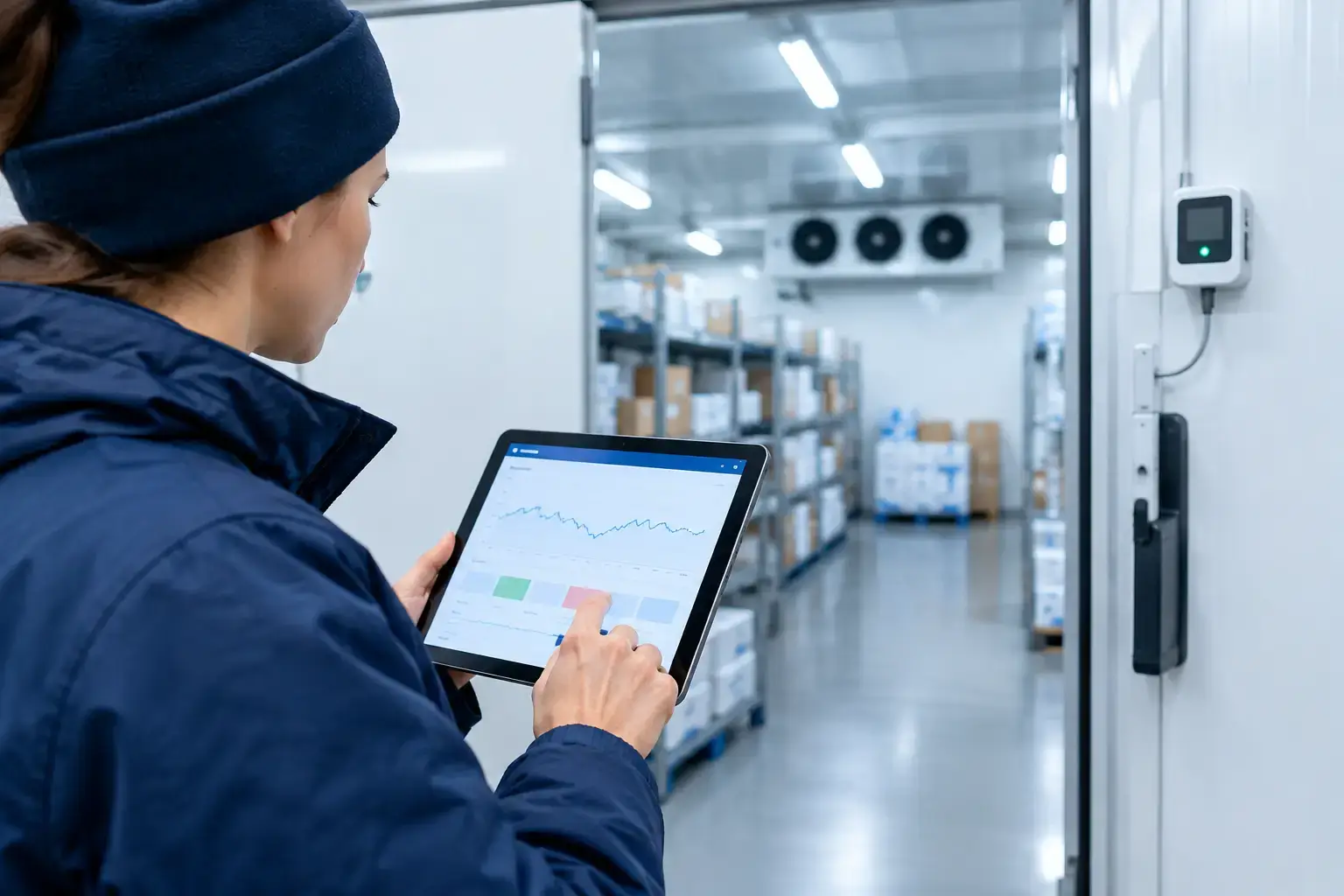
Learn how to track cold room excursions with audit-grade monitoring, escalation workflows, and records that protect inventory, compliance, and margins.
A cold room can exceed its permitted range for 18 minutes during a loading rush and still create a serious quality, compliance, or commercial problem. The difference between a controlled event and an audit finding is not whether an alarm sounded. It is whether the business can prove how to track cold room excursions, who acted, what stock was affected, and why the issue did not recur.
For warehouses, food manufacturers, pharmaceutical distributors, and logistics operators, temperature monitoring is an operational control. It protects product integrity, supports customer commitments, and gives management a defensible record when a customer, auditor, or regulator asks for evidence.
How to Track Cold Room Excursions From Detection to Closure
A cold room excursion occurs when measured conditions move outside the approved operating limits for a defined period. Temperature is the most common parameter, but the same discipline can apply to humidity, door-open duration, power loss, equipment status, and sensor connectivity.
Tracking begins by defining the limits that matter for each room, product category, and process. A chilled produce store, frozen food room, vaccine store, and temperature-controlled staging zone should not inherit one generic threshold. Operating limits must be based on product specifications, validated procedures, customer contracts, and applicable regulations.
The system should capture the actual measured value, the timestamp, the duration outside the limit, the sensor and location involved, and the status of the event. Just as importantly, it should distinguish a brief, accepted operational fluctuation from an excursion requiring investigation. Without this context, teams either receive too many alarms and ignore them or receive alerts too late to protect stock.
A practical workflow has five control points: detect, notify, contain, investigate, and close. The temperature record is the evidence layer. The workflow around it is what turns data into accountable action.
Build the Monitoring Baseline Before You Automate Alerts
Reliable excursion tracking depends on sensor placement and data quality. A sensor installed beside an evaporator coil, directly in an airflow path, or next to a frequently opened door may report conditions that do not represent the products being stored. Conversely, one sensor at the center of a large cold room can miss a warm zone near a loading bay or a failing refrigeration circuit.
Map the room before selecting sensor locations. Consider room size, racking layout, airflow, door positions, cooling units, staging areas, and the location of high-risk or high-value stock. Larger rooms may require multiple sensors, especially where pallets are stored at different heights or where inbound and outbound activity creates local temperature variation.
Each sensor needs a unique asset ID, physical location, calibration status, and defined owner. Calibration records should be tied to the device record, not stored separately in an email folder that operations cannot access during an audit. If a sensor has drifted beyond tolerance or has stopped transmitting, the gap itself must become an exception that receives attention.
Sampling frequency also involves a trade-off. Very infrequent readings can conceal short but material events. Extremely high-frequency readings can create unnecessary data volume and noise if the alarm logic is not designed properly. For most operations, the right approach is continuous or frequent telemetry combined with rules that evaluate duration, rate of change, and severity rather than reacting to every minor fluctuation.
Set Alarm Rules That Match Operational Risk
A useful alert is specific enough to trigger action and smart enough to avoid alarm fatigue. Set an approved temperature band, then configure warning and critical thresholds around it. For example, a warning may notify the cold room supervisor when the temperature approaches the upper limit, while a critical alert may immediately escalate to quality, maintenance, and the operations manager when the limit is exceeded for a defined duration.
Duration matters. A door opening may cause a short temperature rise that returns to normal quickly. A sustained increase after the door closes may indicate a refrigeration issue, an obstructed airflow path, or a failed operational control. Rules should therefore account for both the value and the elapsed time outside the accepted range.
Alert routing should follow the shift structure. Sending a message to a shared inbox is not an escalation plan. Assign alerts by site, room, severity, and time of day. The on-duty team should receive the first notification, while unresolved critical events should escalate automatically to a named supervisor and then to the relevant quality or technical owner.
For multi-site operations, a central dashboard should show rooms in normal condition, rooms in warning state, active excursions, disconnected sensors, and overdue corrective actions. This gives corporate quality and supply chain leaders visibility without forcing site teams to build manual daily reports.
Connect Excursions to Product and Inventory Decisions
A temperature chart alone does not tell the business what to do with affected inventory. The real operational question is which lots were in the room, where they were positioned, how long they were exposed, and whether they can be released, reworked, transferred, or quarantined.
Integrate cold room telemetry with warehouse and inventory records wherever possible. When an event occurs, the team should be able to identify affected SKUs, batches, expiry dates, pallet locations, customers, and shipment commitments. This is especially valuable where FEFO rules apply, where stock belongs to multiple clients, or where a 3PL operator needs to provide transparent evidence to customers.
The containment workflow should place potentially affected stock into a controlled status pending review. That does not always mean every item in the room must be written off. The decision depends on validated stability data, exposure duration, product type, and quality procedures. However, allowing stock to remain available for picking while the investigation is unresolved creates avoidable risk.
A capable warehouse platform can enforce this decision operationally. It can block allocation, prevent dispatch, direct teams to move stock to an alternate room, and record every status change. This is far stronger than a paper note taped to a pallet or a WhatsApp instruction that cannot be traced later.
Record the Investigation, Not Just the Temperature
Every excursion should produce an audit-grade event record. The record should show when the deviation started and ended, the highest or lowest measured value, the room and sensor involved, notifications sent, acknowledgments received, actions taken, stock affected, and final disposition.
The investigation should capture the probable cause with evidence. Common causes include doors left open, high inbound activity, refrigeration failure, power interruption, defrost cycle issues, poor loading practices, damaged door seals, and sensor faults. Avoid using vague closure notes such as "resolved" or "temperature normalized." They do not demonstrate control, and they do not help prevent repeat events.
Corrective and preventive actions need owners and due dates. If maintenance repaired a condenser, attach the work order reference. If a team needs retraining on loading discipline, record the attendance and verify the result. If the root cause is recurring door-open time, consider installing door sensors, revising traffic flow, or creating a staging process that reduces exposure.
This is where workflow automation delivers value beyond monitoring. Snapdec can connect telemetry, task assignment, approvals, maintenance requests, warehouse inventory status, and management dashboards in one accountable process. Teams use the same operational record on the floor, while leadership receives traceable data for risk and performance decisions.
Measure Patterns Before They Become Losses
Individual events matter, but recurring patterns usually reveal the larger cost. Review excursion data by room, shift, site, sensor zone, duration, root cause, and product category. A room with frequent short excursions during the afternoon may have a loading process problem. Repeated events after maintenance may point to an equipment sizing issue or an incomplete repair.
Track operational measures such as excursion count, total excursion minutes, mean time to acknowledge, mean time to stabilize, overdue investigations, sensor uptime, and value of stock placed on hold. These indicators make the discussion more useful than simply reporting that a room was "within range" for most of the month.
Do not treat every deviation as proof that the refrigeration system has failed. Some events are process-driven, and some are caused by weak sensor coverage or poor alert design. The objective is to identify the control failure quickly, contain its impact, and create a record that stands up to scrutiny.
A cold room program earns trust when it works at 2:00 a.m., during a busy dispatch window, and when an auditor asks for last quarter's evidence. Build the process so the next alert produces a clear action, a defensible decision, and a better-controlled operation.
KEEP READING
Want the version that applies to your operation?
Articles only go so far. Book a no-obligation session and we'll walk your process end to end.
Book a demo →